
Understanding the Pre-Lawsuit Examination Every Injured Sanitation Worker Should Know
Key Takeaways: A 50-h hearing is a recorded, pre-lawsuit examination that the City of New York may demand after you file a notice of claim, allowing it to question you under oath about how your injury occurred and its severity. Because DSNY is a city agency, this examination becomes mandatory once the City properly demands it in writing within 90 days of the notice of claim. Skipping a valid demand can lead to dismissal. You retain key rights, including having an attorney and physician present and receiving a full transcript. Line of Duty Injury (LODI) benefits and a municipal lawsuit are separate paths, and the 50-h process may allow recovery beyond what LODI benefits provide.
A 50-h hearing is a recorded, pre-lawsuit examination that the City of New York may demand after you file a notice of claim, allowing the City to question you under oath about how you were hurt and the severity of your injuries. For a Bronx sanitation worker pursuing a claim against DSNY, this step is not optional once the City demands it. The examination allows a municipality to question a claimant after a notice of claim is filed, covering the occurrence and extent of injuries or damages. Because DSNY is a city agency, any lawsuit against it generally triggers these procedural rules, making the examination a critical checkpoint.
💡 If you were injured in the line of duty, treat the 50-h hearing as one piece of a larger procedural puzzle, not as the finish line.
If you are a DSNY employee or supervisor recovering from a Line of Duty Injury, the team at The Law Offices of Dennis P. Ryan can help you navigate each deadline. Call us at 212.441.4352 to discuss your situation, or reach out through our contact page to take the next step.
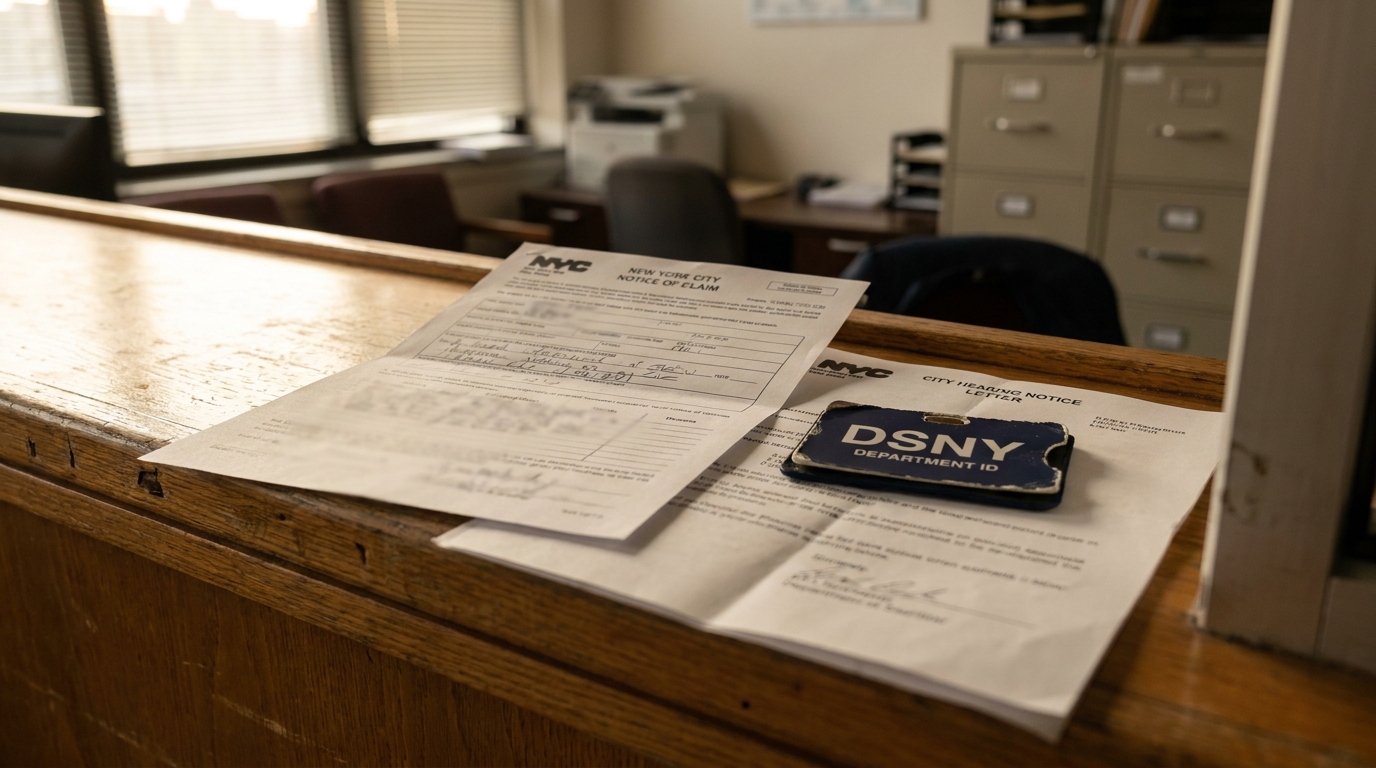
Why the City Can Demand This Examination
The 50-h hearing exists so municipalities can investigate claims before litigation. New York requires formal, timely notice of claims against public entities so the City can assess liability and decide whether to resolve a dispute early. This framework is why injured workers face strict procedural hurdles that don’t exist in ordinary private injury cases.
The City uses this opportunity to lock in your account of events and evaluate your damages. Understanding that purpose helps you prepare honestly and carefully, because your testimony becomes part of the record.
Strict written notice rules run throughout New York’s municipal claim system. Missing these deadlines, which are generally 90 days after the claim arises under New York General Municipal Law Section 50-e, can bar an injured worker’s case, although a court may in limited circumstances grant permission to serve a late notice of claim. That is why understanding the purpose of a notice of claim for Bronx city workers is so important before any examination is scheduled.
The Notice of Claim: The Gateway to Everything
Before any DSNY lawsuit can move forward, you must serve a formal notice of claim on the City. This is the threshold requirement that opens the door to the entire process. No personal injury or property damage action against a municipal entity, including NYC Department of Sanitation, can proceed without first satisfying this prerequisite.
Under New York’s Civil Practice Law Section 9801, no action shall be maintained against the village for a personal injury or injury to property alleged to have been sustained by reason of the negligence or wrongful act of the village or of any officer, agent or employee thereof, unless a notice of claim shall have been made and served in compliance with section fifty-e of the general municipal law. For cities like New York City, the equivalent notice of claim requirement is found in General Municipal Law Section 50-i. You can review the underlying statutory prerequisites for municipal claims to see how strictly New York treats this step.
💡 Pro Tip: Preserve your LODI and Unusual Occurrence reports immediately. These internal DSNY records often become critical evidence and can disappear if you wait too long to request copies.
How a 50-h Hearing Fits Into Your DSNY Lawsuit
The 50-h examination is a mandatory pre-litigation step once the City properly demands it. The demand for examination must be in writing, served personally or by registered or certified mail, and must specify the person conducting it, time, place, and subject matter. A demand that fails to meet these requirements may not be effective.
Timing controls whether the City’s demand counts. The demand must be served within 90 days of the notice of claim filing, or it is not effective. If the City misses that window, the demand generally loses its force.
Compliance with a valid demand is a true prerequisite to filing suit. No action can be commenced against the city unless the claimant has complied with the demand for examination. A worker who skips a properly demanded 50-h hearing risks dismissal before the case is heard on the merits.
What Actually Happens During the Examination
The examination is conducted under oath, with a full transcript taken. The claimant has the right to be represented by counsel, and the examination is conducted under oath with a full transcript taken. This is sworn testimony, so accuracy and preparation are essential.
By default, the questioning is oral and may include a medical component. The examination shall be upon oral questions unless the parties otherwise stipulate and may include a physical examination by a qualified physician. You retain important protections: A claimant is entitled to have the examination in the presence of their own physician and such relative or other person as they may elect.
Here is a quick overview of your core rights at the hearing:
- The right to have an attorney present and represent you
- The right to have your own physician attend
- The right to bring a relative or another person of your choosing
- The right to a complete transcript of the proceeding
| Procedural Element | General Rule |
|---|---|
| Form of demand | Written; served personally or by registered or certified mail |
| Deadline to serve demand | Within 90 days of notice of claim filing |
| Default format | Oral questions, possible physical exam |
| Compliance | Required before commencing a lawsuit |
💡 Pro Tip: Bring documentation of your medical treatment, lost chart and overtime wages, and any pension impact to your hearing. Concrete records help establish the full extent of your damages.
Deadlines That Can Make or Break a Bronx DSNY Injury Claim
Several overlapping timelines govern a DSNY lawsuit, and missing any one can be fatal. Beyond the notice of claim, New York law builds in a waiting period before suit. The claimant must file a timely notice of claim and allow the statutory waiting period to elapse before commencing the lawsuit, and failure to comply can bar the action. You can review the 30-day waiting period statute to understand how this rule interacts with the examination schedule.
The statute of limitations adds another layer of timing pressure. For tort claims against a municipality, the limitations period is generally one year and ninety days measured from when the claim accrued. Under New York Civil Practice Law, accrual-based limitations generally run from when the claim arises, with discovery-based accrual applying only to limited categories. Courts interpret discovery and tolling exceptions narrowly, so don’t assume any extension applies automatically.
💡 Pro Tip: Calendar every deadline the moment you are injured. The notice of claim deadline, the waiting period, and the statute of limitations each run on separate tracks.
Workers’ Compensation and a Lawsuit Are Two Different Paths
Injured DSNY workers in the Bronx may have rights under Line of Duty Injury (LODI) benefits and a separate municipal injury lawsuit. These systems run parallel and sometimes intersect. Sanitation workers employed by DSNY who are injured while performing duties are NOT entitled to workers’ compensation benefits under New York law; they are excluded from the workers’ compensation system and instead receive Line of Duty Injury (LODI) benefits, which may include full salary and medical coverage, and they retain the right to sue the City of New York directly for negligence.
The City of New York self-insures its workers’ compensation obligations for covered City employees and does not use the New York State Insurance Fund; however, uniformed DSNY sanitation workers are excluded from the workers’ compensation system entirely and instead receive Line of Duty Injury (LODI) benefits. Pursuing a DSNY lawsuit through the 50-h hearing process is a separate legal avenue that may allow recovery of damages beyond what workers’ compensation or LODI provides, particularly when a third party or the City’s own negligence is involved. To learn more about how these cases work, our overview of sanitation worker injuries in The Bronx offers helpful background. Outcomes depend heavily on the specific facts of each case.
Frequently Asked Questions
1. Is a 50-h hearing the same as my lawsuit?
No. The 50-h hearing is a pre-lawsuit examination, not the trial. It allows oral questioning about the occurrence and extent of injuries. Your civil case proceeds separately afterward.
2. Can I have a lawyer with me at the examination?
Yes. The claimant has the right to be represented by counsel, and the examination is conducted under oath with a full transcript taken. Having representation can help protect your interests during sworn questioning.
3. What happens if I ignore the City’s demand for examination?
Ignoring a valid demand can prevent your case from moving forward. No action can be commenced unless the claimant has complied with the demand for examination. Noncompliance often leads to dismissal.
4. How long does the City have to demand the examination?
The City must act promptly. No demand for examination is effective unless it is served within ninety days from the date of filing of the notice of claim. A late demand may not be enforceable.
5. Does workers’ compensation prevent me from filing a lawsuit?
Not necessarily. Injured sanitation workers may be entitled to Line of Duty Injury (LODI) benefits, while a separate municipal lawsuit may remain available under certain circumstances. The interaction depends on who was at fault and other case-specific factors.
Protecting Your Rights After a Line of Duty Injury
A 50-h hearing is a pivotal, sworn step in nearly every Bronx DSNY injury claim, sitting between your notice of claim and your eventual lawsuit. The process carries strict deadlines, formal demand requirements, and important rights that can shape your recovery. Because these rules are unforgiving and highly fact-dependent, understanding them early gives injured sanitation workers the best footing. Nothing here is individualized legal advice, and results always turn on the particular facts of your case.
If you are an injured DSNY worker weighing your options, the attorneys at The Law Offices of Dennis P. Ryan are ready to help you understand each step. Call us today at 212.441.4352 or request a consultation online to discuss how to protect your claim.