
Height, Gravity, and the Law That Puts Responsibility Where It Belongs
Key Takeaways: New York’s Scaffold Law, Labor Law § 240(1), requires owners, contractors, and their agents to provide and properly place safety devices such as scaffolds, ladders, hoists, and pulleys for workers doing elevated work. When a missing or inadequate device causes a gravity-related injury, liability may be treated as strict and non-delegable, meaning a worker’s own comparative negligence is generally not a defense unless the worker’s conduct was the sole proximate cause. Labor Law § 241(6) works alongside it, generally requiring violation of a specific Industrial Code provision and allowing comparative fault to reduce recovery, while § 241(5) imposes detailed protections around shafts and floor openings. Workers’ compensation and a third-party Labor Law claim are separate tracks that often proceed together, with pain and suffering generally recoverable only through the third-party action, and courts have generally held that immigration status alone does not bar recovery, though it may affect certain wage-related damages. Early evidence preservation, photographs, incident reports, witness names, and medical records, can strengthen these fact-intensive claims. Limitations periods and notice requirements vary by defendant and theory, so a prompt case-specific review is important for Queens workers.
New York’s Scaffold Law, codified at Labor Law § 240(1), requires owners, contractors, and their agents to furnish and properly place safety devices such as scaffolds, hoists, ladders, and pulleys so workers performing elevated tasks are protected from gravity-related hazards. When that duty is breached and found to be a proximate cause of injury, courts apply a strict, non-delegable liability standard rather than an ordinary negligence analysis. For a worker who fell from staging in Astoria or was struck by a dropped beam in Long Island City, that distinction can shape the entire case.
If you or a loved one was hurt on a Queens jobsite, The Law Offices of Dennis P. Ryan is available to review what happened and explain the remedies that may apply. Call 212.441.4352 or reach out to our team today to discuss your situation.
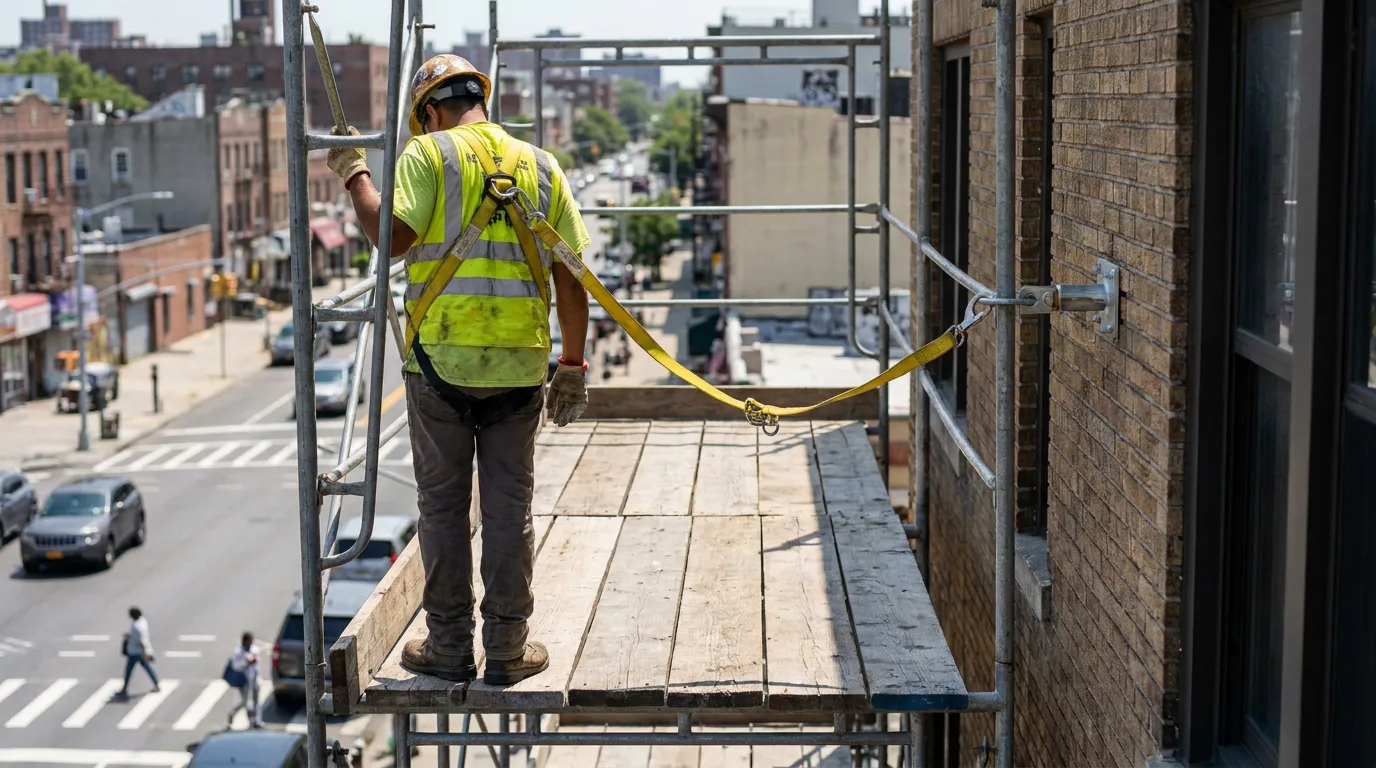
Understanding Scaffold Law Absolute Liability in New York
"Absolute liability" describes a liability standard, not a guarantee of recovery. Where a plaintiff proves a statutory safety device was absent or inadequate and that this failure proximately caused an elevation-related injury, an owner or general contractor may be held liable even without ever setting foot on the site. Commentary from policy organizations, including an Empire Center liability law report, describes New York as the only state maintaining this framework rather than comparative fault; that characterization comes from an advocacy source and is contested by worker-side commentators.
Still, courts refuse to treat the statute as a blanket insurance policy. Defendants regularly litigate whether the work was covered activity, whether the injury was truly gravity-related, whether an adequate device was available but unused, and whether the worker’s own conduct was the sole proximate cause. These fact-intensive questions depend heavily on the evidence developed in each case.
Why the Standard Exists
New York has recognized construction as inherently dangerous work for over a century. Workers’ Compensation Law § 3(1), Group 3, classifies construction of bridges, buildings, structures, subways, and similar projects as hazardous employment, reflecting a policy rationale similar to the one courts cite in applying strict liability to falls and falling-object injuries, though the statutes serve different purposes.
The debate remains active in Albany. Bills have been introduced proposing to narrow, clarify, or expand Labor Law §§ 240 and 241, and the official Assembly bill-tracking record preserves their summaries and full text. None has changed the standard described here. Critics point to insurance and construction cost pressures, while worker advocates emphasize that the rule places the burden of safety planning on the parties who control budgets and schedules.
How Labor Law § 241(6) Works Alongside the Scaffold Law
Labor Law § 241(6) is the general construction safety statute, and it operates differently from § 240. The New York construction safety statute requires that construction, excavation, or demolition areas be "so constructed, shored, equipped, guarded, arranged, operated and conducted as to provide reasonable and adequate protection and safety" to those employed or lawfully present. It reaches owners, contractors, and their agents, with a carve-out for owners of one- and two-family dwellings who contract for but do not direct or control the work.
A § 241(6) claim generally requires identifying a specific, concrete Industrial Code provision that was violated, rather than a general safety standard. Unlike § 240(1), comparative fault may reduce recovery under § 241(6), making careful pleading important. Many Queens cases are brought under both provisions plus common-law negligence and Labor Law § 200, so alternative theories can survive if one falls away at summary judgment.
Prescriptive Duties Around Openings and Shafts
Labor Law § 241(5) shows how detailed these obligations can be. Where elevators, elevating machines, or hod-hoisting apparatus are used in the course of construction for the purpose of lifting materials, the shafts or openings in each floor and at each landing level must be enclosed or fenced in on all sides by a barrier of suitable height. Up to two sides used for taking off and putting on materials may instead be guarded by an adjustable barrier positioned not less than three nor more than four feet from the floor and not less than two feet from the edges of such shafts or openings. Unguarded floor openings remain a persistent hazard on multi-story projects across the borough.
Injuries That Frequently Fall Within These Statutes
- Falls from scaffolds, ladders, staging planks, or unguarded roof edges
- Injuries from collapsing scaffolds, temporary platforms, or shoring
- Being struck by tools, materials, or debris falling from an upper level
- Hoist, sidewalk shed, and elevator shaft incidents on mid-rise sites
- Falls through unprotected or improperly covered floor openings
💡 Pro Tip: Photograph the equipment involved before it is repaired or removed. Scaffolding and ladders are often reconfigured within hours of an incident, and contemporaneous images of missing guardrails or damaged planking can become important evidence.
Comparing the Two Central Worker Protection Statutes
| Feature | Labor Law § 240 | Labor Law § 241(6) |
|---|---|---|
| Core hazard | Elevation and gravity-related risks | General construction site safety conditions |
| Liability standard | Strict, non-delegable | Negligence-based, tied to a specific Industrial Code violation |
| Effect of worker’s fault | Generally not a defense, absent sole proximate cause | Comparative fault may reduce recovery |
| Who owes the duty | Owners, contractors, agents | Owners, contractors, agents |
| Common exception | Sole proximate cause; recalcitrant worker; one- and two-family homeowner carve-out | One- and two-family homeowner carve-out |
What Compensation Can Look Like After a Queens Construction Site Fall
Workers’ compensation and a Labor Law claim are separate tracks that often proceed at the same time. Compensation generally provides medical treatment and partial wage replacement regardless of fault, but it does not pay for pain and suffering, and it is ordinarily the exclusive remedy against the employer. A third-party action against the site owner, general contractor, or another responsible entity is where damages for pain, suffering, diminished earning capacity, and loss of household services are usually pursued.
Courts have generally held that immigration status alone does not disqualify an injured construction worker from pursuing these remedies, though it can affect how certain lost-earnings damages are calculated. Many workers hesitate to come forward for that reason, and that hesitation can cost them evidence and deadlines. If you are weighing your options, our firm handles queens scaffold injury matters and can explain how the pieces fit together in your circumstances.
Documentation That Tends to Strengthen a Claim
The strongest cases are usually built in the first several weeks. Incident reports, names of witnessing coworkers, daily logs, safety meeting sign-in sheets, subcontractor agreements, and site photographs from the day of the accident all matter. Medical records connecting the injury to the incident from the outset may also reduce later disputes about causation.
💡 Pro Tip: Report the injury to your employer in writing even if you plan to bring a third-party claim. Verbal notice is easy for an insurer to dispute later.
Filing Deadlines and Why Waiting Is Risky
Personal injury claims in New York are governed by limitations periods, and missing one can end an otherwise strong case. Most construction injury actions fall under the three-year period in CPLR § 214(5), measured from the date of the accident. A narrower set of claims is measured from discovery of the underlying facts; for those, CPLR § 203(g)(1) requires the action be commenced within two years after actual or imputed discovery, or within the otherwise applicable period from accrual, whichever is longer. Discovery and tolling provisions apply only in defined circumstances and are generally construed narrowly.
Deadlines also differ depending on the defendant. Claims involving public entities or public construction projects typically require a notice of claim within 90 days and a shortened suit deadline, and those administrative steps do not substitute for timely filing a lawsuit. Because the applicable period depends on the parties, theory of liability, and nature of the injury, an early case-specific review is generally advisable. Additional discussions are available on our construction accident lawyer resource library.
Frequently Asked Questions
1. Does the Scaffold Law apply only to scaffolds?
No. Despite the nickname, the statute addresses elevation-related risks broadly, including ladders, hoists, pulleys, staging, and falling-object hazards. The key question is generally whether the worker was engaged in covered work and whether the injury flowed from gravity and the absence or inadequacy of a required safety device.
2. Can I still recover if I made a mistake at work?
In many cases, recovery may still be possible. Under the strict standard applied to § 240(1) claims, a worker’s comparative negligence is generally not a defense, though defendants may argue the worker’s conduct was the sole proximate cause. That argument is fact-dependent and frequently contested.
3. Am I covered if the injury happened at a small house renovation?
It depends on the property and the owner’s role. The statutory carve-out applies to owners of one- and two-family dwellings who contract for but do not direct or control the work. Where an owner supervises the job or the property is used commercially, the exception may not apply.
4. Does receiving workers’ compensation prevent a Labor Law claim?
Generally not, when a third party may be responsible. Compensation benefits are ordinarily the exclusive remedy against your direct employer, but they usually do not prevent an action against a site owner, general contractor, or equipment manufacturer. Any recovery may be subject to a compensation lien.
5. What if my employer says the accident was not reported?
Missing paperwork does not automatically defeat a claim. Witness testimony, medical records, photographs, and site documents may help establish what happened. Delay complicates proof, and separate compensation notice deadlines may apply, so acting promptly is advisable.
Where This Leaves Injured Queens Workers
New York’s elevation-related worker protection statutes place responsibility for fall protection and falling-object safety on the owners and contractors who control the jobsite, a framework that remains distinctive nationally even as the legislature debates its scope. A § 240(1) claim, a § 241(6) claim, and a workers’ compensation claim can each address different losses, and they often run in parallel. Every outcome depends on the specific facts, the evidence preserved, and the timeliness of the filing.
If you are trying to understand your rights after a jobsite fall, The Law Offices of Dennis P. Ryan welcomes your call at 212.441.4352. You can also schedule a case review now to have your circumstances evaluated.
Disclaimer: This content is for informational purposes only and is not legal advice. Every case is unique, and results may vary. Consult an attorney about your specific circumstances.