
When a "Small" Sidewalk Crack Becomes a Serious Legal Question in the Bronx
Key Takeaways: New York does not use a fixed measurement to decide whether a sidewalk defect is actionable; courts generally apply a totality of the circumstances test rooted in Trincere v. County of Suffolk, weighing width, depth, elevation, edges, lighting, weather, debris, and the walkway’s general condition and traffic level. For DSNY workers in the Bronx, context matters because sanitation duties often involve carrying heavy loads, moving backward toward a truck, and working under time pressure on compromised surfaces. Responsibility generally falls on the adjoining property owner under NYC Administrative Code § 7-210, while claims against the City add a prior written notice requirement under Administrative Code § 7-201(c)(2). Strict deadlines apply, including a 90-day Notice of Claim under General Municipal Law § 50-e for municipal defendants and a three-year personal injury limitations period under CPLR 214, shortened to one year and 90 days for most claims against the City. Because defendants frequently move for dismissal on triviality grounds, early photographs, measurements, LODI and Unusual Occurrence reports, medical records, and witness information can significantly affect whether a claim survives.
A raised slab of only an inch can end a sanitation worker’s shift, and sometimes a career. New York courts generally do not decide these cases with a ruler. Instead, they apply a totality of the circumstances test weighing the size, shape, location, lighting, and surrounding conditions of the defect against how the injury happened. For DSNY workers hurt on a Bronx route, that framework often determines whether a claim moves forward or is dismissed as legally trivial.
If you were injured on a Bronx sidewalk while performing your duties, the team at The Law Offices of Dennis P. Ryan can review how the applicable standard may apply to your facts. Call 212.441.4352 or reach out to our team today to discuss preserving your Line of Duty Injury paperwork and meeting your case deadlines.
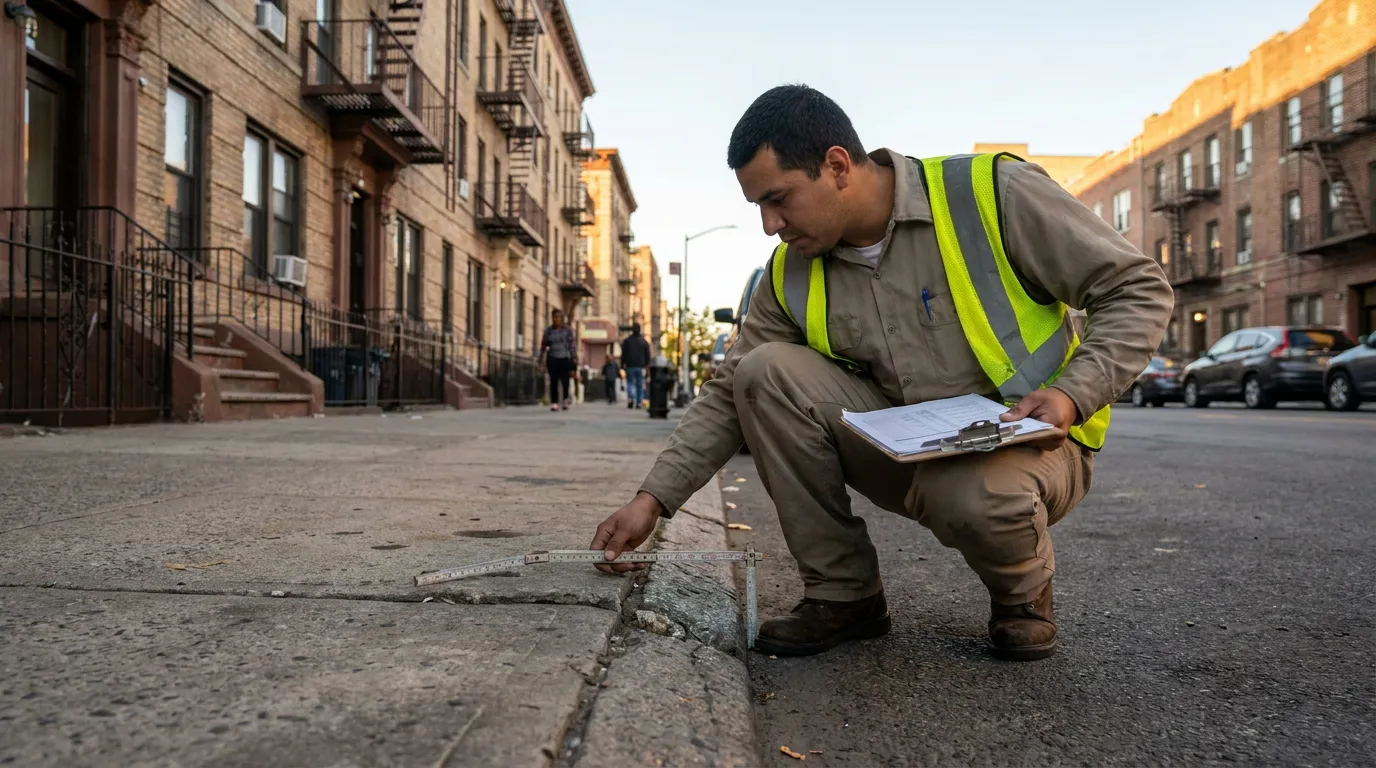
The Doctrine Behind Every de minimis sidewalk defect claim nyc Workers File
New York courts apply the "trivial defect" doctrine, which holds that not every sidewalk irregularity is legally actionable. The doctrine traces to Trincere v. County of Suffolk, which held there is no minimal dimension test and that mechanical disposition based on measurement alone is inappropriate. There is generally no fixed number that automatically renders a defect too small to sue over, although a defendant moving for summary judgment may still establish triviality by showing the defect was physically insignificant and lacked any trap-like characteristic.
That rejection of bright-line rules cuts both ways. A defense attorney generally cannot prevail simply by producing a photo with a tape measure showing a half-inch differential. At the same time, an injured worker should not assume any crack supports liability. The outcome in a de minimis sidewalk defect claim nyc courts evaluate often depends heavily on the developed factual record.
What Courts Actually Weigh
Judges generally look at the defect as a whole rather than at one dimension in isolation. Published New York decisions have examined dimensions, location, lighting, and surrounding conditions when deciding whether a condition was actionable or trivial as a matter of law. Commentary on the trivial defect doctrine in New York identifies size, location, and surrounding conditions as recurring factors.
Courts may consider:
- The width, depth, and elevation differential of the defect
- Whether the edges were jagged, irregular, or beveled
- Lighting and visibility at the time of the incident
- Weather conditions and debris obscuring the hazard
- The general condition of the surrounding walkway
- Whether the location was a high-traffic pedestrian or work area
No single factor typically controls. A modest height differential in a poorly lit area, partially covered by refuse on collection day, may be treated differently than the same differential on a clear, well-lit stretch of pavement.
Why This Standard Matters for Sanitation Workers
Sanitation work places employees on compromised walking surfaces under time pressure, often while carrying or maneuvering heavy loads. A worker stepping backward toward a truck, arms full, may not have the same opportunity to observe a defect as a pedestrian strolling in daylight. Those circumstances can factor into the "time, place, and circumstances" inquiry New York’s negligence test contemplates, though a defendant may still argue comparative fault, which under CPLR 1411 reduces rather than bars recovery.
That context can be legally significant. The same irregularity a court might deem trivial for an unencumbered pedestrian may be evaluated differently when the record shows the worker was performing assigned duties as the City expected. Outcomes remain fact-dependent. Our practice handling Bronx trip and fall matters for DSNY personnel focuses on building that context early.
💡 Pro Tip: Photograph the defect from multiple angles the same day, including a wide shot showing the surrounding walkway and lighting. Conditions get repaired, and a repaired sidewalk is far harder to reconstruct months later.
Who Is Responsible for the Sidewalk You Fell On
Responsibility for New York City sidewalks generally rests with adjoining property owners rather than the City itself. Under NYC Administrative Code § 7-210, property owners are generally obligated to maintain sidewalks abutting their property in a reasonably safe condition, with an exception for owner-occupied one-, two-, or three-family residential properties used exclusively for residential purposes, for which liability generally remains with the City. That allocation can shape who the proper defendant is in many Bronx sidewalk claims.
The City’s sidewalk repair program generates inspection and violation records that can matter later. Big Apple Pothole and Sidewalk Protection Corporation maps and Department of Transportation violation notices may serve as sidewalk claim evidence bearing on notice or on the hazardous nature of a condition, with Big Apple maps functioning principally as a means of satisfying the prior written notice requirement in claims against the City. Identifying the correct responsible party early is important, because suing the wrong entity can waste months of a limited filing window.
The Notice Requirement Layered on Top
Where a municipality is a potential defendant, New York law generally requires proof of prior written notice of the specific defect before liability attaches. The village notice statute at N.Y. C.P.L.R. § 9804 illustrates the principle: no civil action may be maintained for injuries from a defective sidewalk unless written notice of that condition was actually given to the clerk and the municipality failed to repair it within a reasonable time. New York City’s comparable prerequisite appears in Administrative Code § 7-201(c)(2), and courts recognize limited judicial exceptions where the municipality affirmatively created the defect through negligence or derived a special use benefit from the location. Prior written notice requirements generally do not apply to private property owners sued under § 7-210.
Notice and triviality are separate hurdles. Where the City is the defendant, actual or constructive knowledge of a condition generally does not substitute for prior written notice, and even a properly noticed defect may still need to be shown as more than trivial before liability follows. New York General City Law § 20(35) reflects the broader municipal principle that cities may adopt local laws providing for inspection, service of notice on owners, and correction of dangerous conditions.
Deadlines That Can End a Claim Before the Merits Are Reached
Procedural deadlines in claims against public entities are strict, and courts generally interpret exceptions narrowly. Claims against the City of New York and its agencies generally require a Notice of Claim within 90 days of the incident under General Municipal Law § 50-e, separate from and shorter than the civil statute of limitations. Missing that window can be fatal, though a court may grant leave to serve a late notice under General Municipal Law § 50-e(5), generally only if the application is made within the applicable limitations period.
Separately, New York’s official statute of limitations timetable lists personal injury actions under CPLR 214 with a three-year limitations period. For most tort claims against the City, however, General Municipal Law § 50-i shortens that period to one year and 90 days. Do not assume tolling or a discovery rule extends any deadline; such doctrines may apply only in limited circumstances and are not automatic.
| Requirement | General Nature | Practical Effect |
|---|---|---|
| Notice of Claim (municipal defendants) | Administrative prerequisite, typically 90 days | Must generally be served before suit is commenced |
| Personal injury statute of limitations | Civil filing deadline, three years under CPLR 214 | One year and 90 days generally applies to claims against the City |
| LODI / Unusual Occurrence reports | Internal agency documentation | Not a lawsuit, but potentially critical proof of how the injury occurred |
Internal agency reporting is separate from any civil lawsuit. Filing a Line of Duty Injury report generally does not preserve your right to sue, and a civil filing generally does not satisfy agency reporting obligations.
Building the Record That Survives a Triviality Motion
Because defendants frequently raise triviality on summary judgment, the record you build in the first weeks can significantly affect the case. Municipalities and property owners frequently argue that a defect was too minor to be actionable, which can make early documentation more valuable than later testimony. A defect evaluation court proceeding rarely turns on memory alone.
Practical steps that may strengthen a claim include preserving your LODI and Unusual Occurrence reports, requesting copies rather than assuming the agency retains them, obtaining prompt medical treatment that documents the mechanism of injury, and identifying coworkers or bystanders who saw the condition. Measurements taken contemporaneously, ideally with a reference object in frame, can matter considerably. If you are still weighing your options, reviewing our sidewalk injury standard articles may help you understand what typically comes next.
💡 Pro Tip: Ask whether the location has an open DOT violation or appears on a Big Apple map. Those records may bear on notice, and they are easier to locate before a repair crew resurfaces the block.
Frequently Asked Questions
1. Is there a minimum height difference required for a sidewalk defect claim in New York?
No fixed measurement generally controls. New York courts have rejected a minimal dimension test, and a defect’s actionability may depend on a case-specific review of its dimensions along with the time, place, and circumstances of the injury.
2. Does the City always defend a de minimis sidewalk defect claim nyc workers bring?
Not necessarily, but triviality is a common defense argument in New York City premises liability and sidewalk fall cases. Whether it succeeds depends on the factual record developed in the particular case.
3. Can I pursue a civil claim if I already filed a Line of Duty Injury report?
In many cases, yes. Internal agency reporting and a third-party civil action generally serve different purposes, and one generally does not substitute for the other. Separate rules, including workers’ compensation and General Municipal Law § 207-a-type benefit provisions where applicable, may affect recovery against your own employer. An attorney can evaluate how both processes interact with your specific facts.
4. What happens if I miss the 90-day Notice of Claim deadline?
Missing the deadline can bar a claim against a municipal defendant. A court may permit a late notice under General Municipal Law § 50-e(5) in limited circumstances, generally only on application made within the limitations period, so prompt action is important.
5. How do lighting and weather affect a Bronx sidewalk claim?
Courts may consider visibility, weather, and obstructions as part of the totality of the circumstances. A defect that would be obvious in daylight may be evaluated differently when the record shows poor lighting or debris concealing the hazard.
What Injured Sanitation Workers Should Take Away
New York’s approach to sidewalk defects resists easy summary. The totality of the circumstances test generally replaces a measurement contest with a fact-intensive inquiry into what the defect looked like, where it was, and what conditions surrounded it when the injury occurred. For sanitation workers in the Bronx, that means the strength of a claim may depend on evidence gathered quickly, on identifying the correct responsible party under city sidewalk liability rules, and on satisfying notice and limitations requirements that courts generally enforce strictly. Every case turns on its own facts, and no general discussion can predict how a particular claim will be resolved.
If you are a DSNY employee or supervisor injured on a Bronx walkway, The Law Offices of Dennis P. Ryan is available to review your circumstances and explain the standards that may apply. Call 212.441.4352 or schedule a case review now before critical evidence and deadlines slip away.
Disclaimer: This content is for informational purposes only and is not legal advice. Every case is unique, and results may vary. Consult an attorney about your specific circumstances.